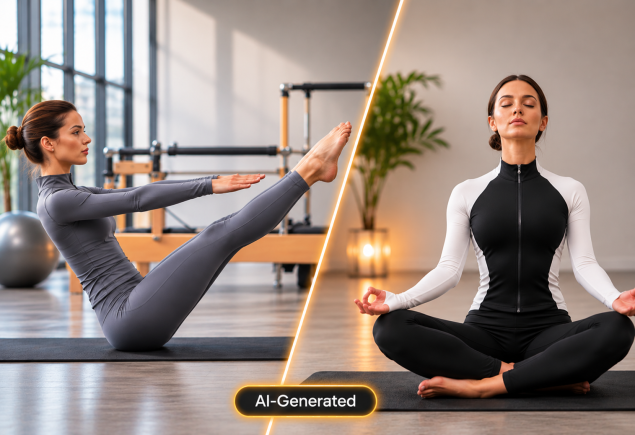
From the outside they look like cousins: a mat, bare feet, slow controlled movement, people breathing on purpose. That resemblance is why the question comes up so often - and why so many people pick one almost at random.
They were built for different reasons, and that difference still shapes every class you will walk into.
The short answer
Choose yoga if you want flexibility, balance and a mental component — something that settles your head as well as your body.
Choose Pilates if you want core strength, control and precision — particularly if your back or posture is the reason you are looking.
If that already decided it for you, skip to the last section. If not, the rest explains why.
Where they come from
Yoga is old. It grew out of Indian philosophical and spiritual traditions over thousands of years, and physical postures were only ever one part of it. Most Western classes today focus on the movement, but the breathing and the stillness at the end are not decoration — they are the original point.
Pilates is barely a century old. Joseph Pilates developed it in the early 1900s, partly while working with people who were injured or immobilised. That origin explains almost everything about it: the obsession with control, the focus on the deep muscles around your trunk, the repetition. It was designed to rebuild bodies, not to still minds.
What a yoga class feels like
Breath leads the movement. You hold postures, flow between them, and the teacher talks you through both. Depending on the style, you might finish dripping with sweat or lying under a blanket.
The styles differ more than beginners expect:
- Hatha - slower, postures held longer, good first class
- Vinyasa - flowing, continuous, more cardiovascular
- Yin - long passive holds, deep connective tissue, very calm
- Iyengar - precise alignment, lots of props, excellent if you have limitations
- Ashtanga - fixed demanding sequence, physically hard
Walking into a Vinyasa class expecting Yin is how people decide "yoga isn't for me" after one session.
What a Pilates class feels like
Smaller movements, more repetition, and a teacher who corrects your position constantly. Nothing looks dramatic. Everything is harder than it looks.
Two formats exist:
- Mat Pilates - bodyweight on a mat, usually in groups, cheapest entry point
- Reformer Pilates - on a spring-loaded machine, often one-to-one or small group, more expensive and more adjustable
The reformer is why Pilates is so widely used alongside physiotherapy: the springs can take load off you as easily as add it.
The main differences
| Yoga | Pilates | |
|---|---|---|
| Built for | Body and mind together | Physical control and rehabilitation |
| Main gain | Flexibility, balance, calm | Core strength, stability, posture |
| Breathing | Leads the movement | Supports the movement |
| Class feel | Varies hugely by style | Consistent, precise, repetitive |
| Equipment | Blocks, straps, bolsters | Mat or reformer machine |
| Mental element | Built in | Mostly absent |
Which should you choose?
Your lower back hurts, or you sit all day → Pilates. The core and postural focus addresses exactly that pattern. If the pain is persistent, see a doctor or physiotherapist first and ask them what they recommend.
You are stressed, sleeping badly, or want something that is not another workout → Yoga. The breathing and the closing stillness are the part people come back for.
You are an athlete and you feel stiff → Yoga, particularly Yin or Hatha.
You want to get stronger but heavy weights are not for you → Pilates. Reformer work especially.
You are recovering from pregnancy or a long break → Pilates is commonly recommended, but this is a case for a qualified teacher who knows your history, not a drop-in class.
You have no idea → Try one class of each. Two hours and the question answers itself.
Can you do both?
Yes, and many people do. They complement each other well: Pilates builds the stability, yoga builds the range of motion. A common pattern is two Pilates sessions and one yoga session a week, or the reverse depending on what you need most.
There is no rule that you must pick a side.
What to look for in a teacher
For yoga, the style matters more than the certificate. Find a teacher whose class you enjoy and whose pace suits you.
For Pilates, qualifications matter more — especially if you are coming in with back pain, an injury or after pregnancy. Ask what training they have and whether they have worked with your situation before. A good teacher will answer that without hesitation.
In both cases, a few private sessions at the start are worth more than they cost. Group classes cannot correct what a teacher cannot see.
Finding a teacher near you
On BeMyPrivateTrainer you can find verified yoga and Pilates teachers in your city, compare their specialisations, styles and prices, and contact them directly. Many offer a first session at a reduced rate so you can find out which of the two suits you before committing to anything.
This article was created with the support of artificial intelligence and reviewed by the BeMyPrivateTrainer team.
No comments yet. Be the first to share your thoughts.